/26/1/photo_2025-03-27_00-10-51.jpg)
Sayyid Al-Hakeem Continues Explaining Imam Al-Sajjad’s Epistle on Rights: Emphasis on Radiance of the Face and the Principle of Guardianship in Islam
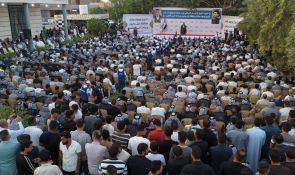
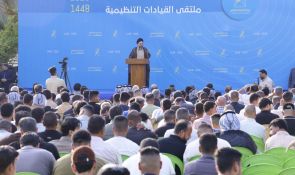
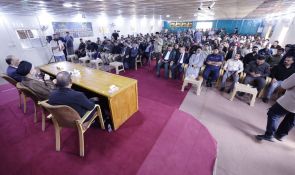
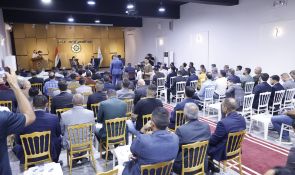
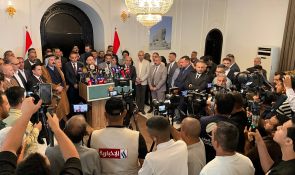
As part of his continued commentary on The Epistle on Rights by Imam Ali ibn Al-Hussein, Al-Sajjad (peace be upon him), Sayyid Ammar Al-Hakeem, Head of the National State Powers Alliance, resumed his Ramadan lecture focusing on the tenth impact of the Tenth Right—the Right of Prayer. In this session, H.E. addressed the concept of forgiveness as one of the most profound outcomes of prayer in human life.
H.E. then turned to the eleventh impact of prayer, known as radiance of the face, referencing verse 29 of Surah Al-Fath:
“Mohammed is the Messenger of Allah, and those with him are firm against the disbelievers, merciful among themselves. You see them bowing and prostrating, seeking bounty from Allah and His pleasure. Their mark is on their faces from the trace of prostration...”
H.E. highlighted several insights and lessons drawn from this verse.
H.E. noted that the Qur’an presents the Prophet Mohammed (peace and blessings be upon him and his family) as the ultimate role model, emphasizing that the verse outlines the foundations of relationships in Islam—both with non-believers and among the faithful. A true believer, H.E. stated, interacts with others based on faith-driven values, rather than personal or sectarian motives. H.E. also stressed the importance of manifesting one’s faith through daily acts of worship, particularly consistent prayer and sincere devotion to Allah.
H.E. further explained that prayer should be a constant and unwavering part of a believer’s life, with bowing and prostration being essential pillars symbolizing humility and submission before Allah. The “bounty” mentioned in the verse, H.E. noted, encompasses both worldly blessings and rewards in the hereafter—urging believers to seek Allah’s grace and approval in both realms.
In the second part of the lecture, H.E. addressed the twelfth impact of prayer—guardianship (wilayah)—referencing verse 55 from Surah Al-Ma’idah:
“Your only guardian is Allah, His Messenger, and those who believe—those who establish prayer and give alms while bowing in worship…”
H.E. emphasized that this verse was revealed regarding the Commander of the Faithful, Imam Ali (peace be upon him), and that the Prophet Mohammed (peace and blessings be upon him and his family) clarified its meaning during the event of Ghadir Khumm.
H.E. stressed the central role of guardianship in Islam, linking it directly to faith and righteous deeds. H.E. explained that Allah commanded the Prophet to proclaim this guardianship in verse 67 of the same surah, affirming that without it, the religion would have remained incomplete.
H.E. concluded by underscoring the need to deepen our understanding of such foundational spiritual principles and to incorporate them into our daily lives. By doing so, H.E. affirmed, we can help build a strong, cohesive society rooted in faith, worship, and righteous action.