/8/1/photo_2025-03-09_09-54-52.jpg)
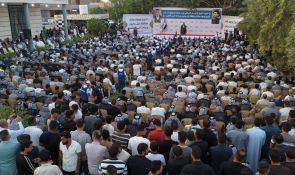
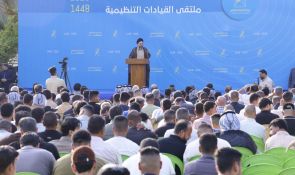
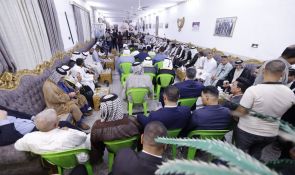
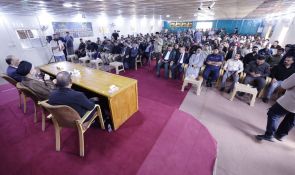
Sayyid Al-Hakeem in Ramadan Lecture: “Prayer’s Virtue, Commitment Importance”
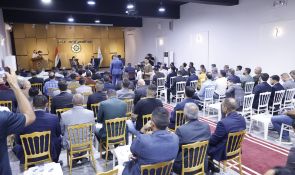
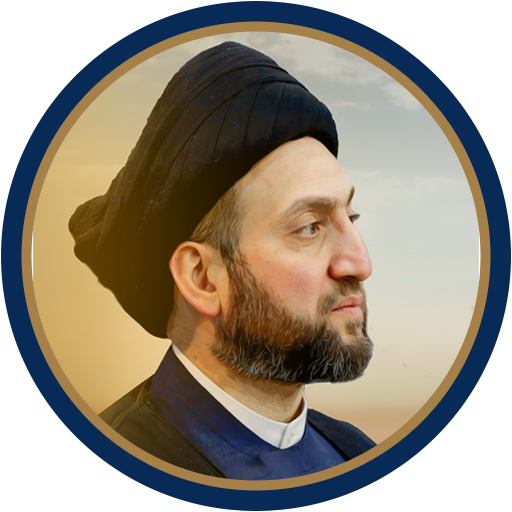
In today's lecture, part of His Eminence’s ongoing Ramadan series, Sayyid Ammar Al-Hakeem, Head of the National State Powers Alliance, continued his explanation of Epistle on Rights by Imam Ali ibn Al-Hussein, Al-Sajjad (peace be upon him). H.E. focused on the tenth right concerning "The Right of Prayer," elaborating on the second insight related to its virtue and significance, emphasizing the greatness of this act of worship in a Muslim's life.
Sayyid Al-Hakeem referenced several Qur’anic verses that highlight the merit of prayer, including:
"And those who believe in the Hereafter believe in it, and they are maintaining their prayers." (6:92 Holy Quran)
"Except for those who pray, those who are constant in their prayer." (70:22 Holy Quran)
"Indeed, prayer has been decreed upon the believers at prescribed times." (4:103 Holy Quran)
Additionally, Sayyid Al-Hakeem cited Prophetic traditions that underscore the importance of prayer, mentioning the saying of Prophet Mohammed (peace and blessings be upon him and his family): "On the Day of Judgment, a servant will first be questioned about their prayer. If it is complete, they will be saved; if not, they will be cast into the Fire." H.E. stressed that prayer is not merely a physical act of worship but a key criterion for the acceptance of deeds in the Hereafter.
H.E. also referenced Islamic narrations on the virtue of prayer, including one from Fiqh Al-Ridha (peace be upon him), which describes how divine blessings descend upon the worshipper from the heavens while angels surround them. Furthermore, H.E. quoted Imam Ali (peace be upon him) from Nahj Al-Balagha: "Allah has enjoined faith as purification from polytheism and prayer as a means of humbling arrogance."
Sayyid Al-Hakeem then introduced the third insight related to maintaining prayer, discussing two key aspects: continuity in prayer without neglect and adherence to its prescribed times. H.E. emphasized that prayer should be performed promptly, citing Imam Ali’s (peace be upon him) guidance in Nahj Al-Balagha: "Perform prayer at its appointed time. Do not hasten it out of leisure, nor delay it due to preoccupation. Know that all your deeds depend on your prayer."
H.E. further quoted Imam Al-Sadiq (peace be upon him): "When a servant prays on time and maintains it, the prayer ascends in a pure and radiant state, saying, You have preserved me, may Allah preserve you. But if it is delayed or neglected, it returns darkened, saying, ‘You have forsaken me, may Allah forsake you." H.E. noted that those who safeguard their prayers are not among the heedless.
Concluding his lecture, Sayyid Al-Hakeem addressed instances where delaying prayer beyond its optimal time is permissible, such as performing recommended acts before obligatory prayers, specific situations like the departure from Arafat, or personal and psychological conditions that may affect focus and presence of heart.
H.E. reaffirmed that prayer is a fundamental pillar in a Muslim’s life and must remain a priority, ensuring its proper and devoted observance.